The Whangamumu Whaling Station Track is one of those walks that lingers in memory long after you’ve returned to the car park. It’s not the longest or most challenging track in the Bay of Islands, but the combination of rugged coastal scenery, regenerating native bush, and the haunting industrial remains of New Zealand’s last shore-based whaling operation creates an atmosphere unlike anything else in the region.
This is a walk for people who appreciate history as much as scenery, who find beauty in decay and regeneration happening side by side, and who value the quieter tracks that sit away from the main tourist routes. The rusting machinery, old slipway, and scattered relics of the whaling station sit in a sheltered bay surrounded by recovering forest, creating a powerful sense of place that speaks to both New Zealand’s industrial past and its changing relationship with marine wildlife.
The track appeals to a specific type of walker: those comfortable with moderate difficulty, interested in maritime history, and happy to drive the extra distance to reach the eastern Bay of Islands. It’s not a quick roadside attraction; getting here requires commitment, and the track itself demands reasonable fitness and appropriate preparation. What you get in return is an experience that most Bay of Islands visitors never discover.
Location and Access
Whangamumu sits on the eastern side of the Bay of Islands, south of Rawhiti on the road towards Cape Brett. The main access is from Te Wahapu Road, which branches off Rawhiti Road. Follow the signs to the Whangamumu Track car park, which is clearly marked once you’re in the area.
The drive from Paihia or Russell takes about 40 to 50 minutes, and the roads become progressively more rural and less maintained as you approach the trailhead. The final section on Te Wahapu Road is gravel and can be rough in places, though it’s generally manageable in a standard vehicle with cautious driving. After heavy rain, conditions can deteriorate, so check locally if you’re unsure about road conditions.
Parking at the trailhead is limited—space for perhaps a dozen vehicles in an informal gravel area. It rarely fills completely given how far off the beaten track this location is, but early arrival is sensible during summer holidays or long weekends.
There are no facilities at the trailhead. No toilets, no water, no rubbish bins. Come prepared with everything you need, and plan to take all rubbish out with you. The nearest services are back in Rawhiti or further afield in Russell or Paihia.
Mobile phone coverage is patchy to non-existent in this area. Let someone know your plans before walking, including when you expect to return.
The Track
The Whangamumu Whaling Station Track covers approximately 2 to 2.5km (1.2 to 1.6 miles) one way, with the return journey totaling 4 to 5km (2.5 to 3.1 miles). Most walkers complete this in 1.5 to 2.5 hours including time spent exploring the whaling station ruins and the bay.
The track is graded moderate, and that’s fair. It’s not technically difficult, but there are steep sections, uneven surfaces, tree roots to navigate, and enough elevation change to feel it in your legs. The descent into Whangamumu Bay is particularly steep in places, which means the return climb out requires reasonable fitness.
The track is well-marked throughout with standard Department of Conservation orange markers. The path is clear and impossible to lose in good conditions, winding down through coastal forest before emerging at the bay where the whaling station ruins are scattered.
This walk suits people with moderate fitness who are comfortable on uneven bush tracks. It’s not appropriate for young children or anyone with mobility limitations. The steep sections and rough surfaces require decent footwear and a reasonable level of physical capability.
Coastal Bush
The track descends through regenerating coastal forest that’s recovering well from historical clearing and the impacts of the whaling station era. The forest is dominated by kānuka, tree ferns, and various coastal broadleaf species creating a dense canopy that provides excellent shade even on hot days.
The walking conditions under the forest canopy are pleasant year-round. The shade keeps things cool in summer, and the enclosed nature of the bush provides shelter from wind on blustery days. The track can be muddy in places, particularly the steeper sections where water runoff creates persistently damp conditions.
Birdlife is excellent throughout. Tūī are common and vocal, their complex songs echoing through the forest. Fantails are guaranteed companions, working the understory and often approaching within a metre or two of walkers. Listen for grey warblers in the mid-canopy and watch for kererū, which are regularly seen in this area.
The forest shows clear signs of recovery. Native seedlings are establishing, pest control efforts are having positive impacts, and the overall trajectory is towards healthier, more diverse native ecosystems. Walking through this regenerating forest provides a sense of hope and progress that contrasts interestingly with the industrial ruins you’re walking towards.
First Views of Whangamumu Bay
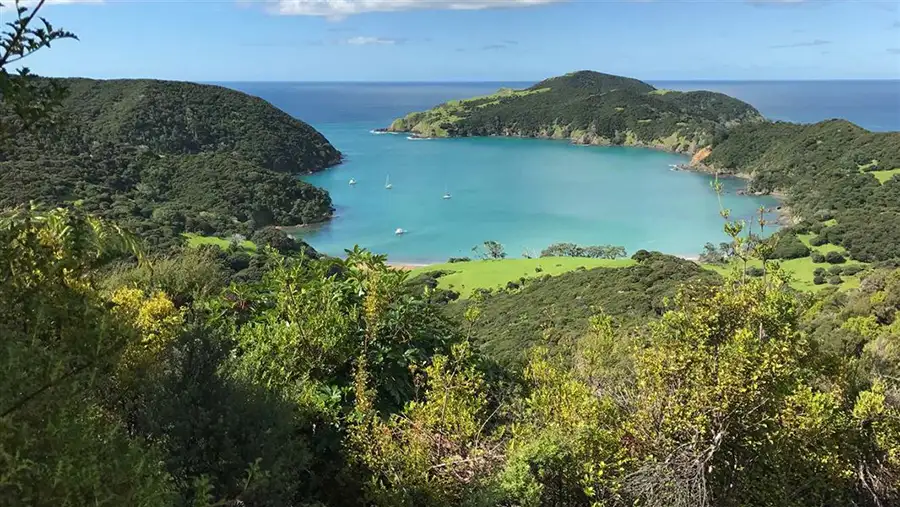
As you descend, occasional gaps in the forest canopy provide glimpses of Whangamumu Bay below. These preview views build anticipation and give you a sense of the landscape you’re entering: a sheltered harbour surrounded by rugged headlands, with clear blue-green water that often sits glassy calm.
The lookout points aren’t formal viewing platforms, just natural breaks in the vegetation where you can pause and take in the scene. The sheltered nature of the bay is immediately apparent—this is why the location was chosen for the whaling station. Protected from the open ocean swells, the bay provided safe anchorage and calm water for the dangerous work of processing whales.
The colours can be stunning, particularly on clear days when the water takes on that vivid turquoise characteristic of the Bay of Islands’ sheltered harbours. The contrast between the dense green forest, the blue water, and the brown-grey headlands creates a rich palette that’s excellent for photography.
Whangamumu Whaling Station
The track emerges at sea level near the ruins of the whaling station, and the impact is immediate. Rusting machinery, the remains of the old slipway, concrete foundations, and scattered industrial debris spread across the shoreline and lower slopes, creating a landscape that’s both haunting and fascinating.
This was one of New Zealand’s last operational shore-based whaling stations. Whaling at Whangamumu began in 1844, though the better-known history dates from 1893 when the Cook brothers George, William and Herbert shifted their operations to the location. What makes Whangamumu unique in whaling history is the method used: rather than hunting whales with harpoons from boats, the operators strung nets across the harbour entrance to catch humpback whales as they migrated along the coast. It was an unusual and ultimately unsustainable approach, but it proved highly effective for several decades. By 1915, they were catching up to 70 humpback whales per year. In 1910, the station adopted motorised harpoon guns, which substantially increased catch rates. The station continued operating on and off through the 1930s before finally closing, with the last significant operations ceasing around 1932 following the economic depression.
The remains you see today include the slipway where whales were hauled ashore for processing, large boilers and tryworks where blubber was rendered into oil, concrete foundations of various buildings, and scattered machinery slowly succumbing to rust and vegetation. The scale of the industrial operation becomes clear as you explore; this was serious heavy industry operating in a remote coastal location.
Interpretive panels, where present (they’ve been vandalized or removed over the years), explain the site’s operation and history. Even without formal interpretation, the ruins tell their own story. The rust, the way native vegetation is slowly reclaiming the site, the contrast between industrial decay and natural regeneration—it’s powerfully atmospheric.
Important: The structures and machinery are old, fragile, and potentially dangerous. Don’t climb on anything, don’t try to move or take relics, and supervise children carefully. The remains are protected under the Historic Places Act, and they’re irreplaceable remnants of New Zealand’s maritime history. Enjoy them, photograph them, but leave them undisturbed.
History and Cultural Significance
Before the whaling station’s establishment, this area was used by Māori for fishing, gathering shellfish, and seasonal occupation. The sheltered bay and abundant marine resources made it valuable, and local hapū maintained connections to this landscape long before European arrival.
The whaling station’s peak activity occurred between the 1890s and 1930s, with the Cook brothers’ operations being the most significant. At its height, it employed dozens of workers and processed substantial numbers of humpback whales during their annual migration along the Northland coast. The unique netting method used here was uncommon compared to the more widespread practice of hunting from boats, but it proved remarkably effective in this sheltered location.
The work was dangerous, difficult, and by modern standards, horrific. Humpback whales, now protected and slowly recovering, were slaughtered in large numbers for their oil and bone. The industry was driven by demand for whale oil for lighting, lubrication, and various other purposes before petroleum products became widely available.
The station’s closure came as whale populations declined from overhunting, as petroleum-based products replaced whale oil in most applications, and as the economic depression of the 1930s reduced demand and prices for whale products. What was once a thriving industrial site was gradually abandoned, left to rust and decay in the coastal environment.
Walking through these ruins today provides a window into New Zealand’s industrial and maritime past, but also serves as a powerful reminder of how dramatically our relationship with marine wildlife has changed. The same species that were hunted to near-extinction here are now protected, and seeing humpback whales in Bay of Islands waters is increasingly common as populations recover.
The site carries both historical and cultural significance. For Māori, it represents a period of significant disruption to traditional practices and marine ecosystems. For New Zealand history broadly, it’s one of the few remaining physical sites documenting shore-based whaling operations.
Coastal Environment
Whangamumu Bay itself is beautiful in a rugged, unmanicured way. The sheltered waters are often calm and clear, protected from ocean swells by the headlands and harbour entrance. Rock pools dot the shoreline, and there are pockets of sandy beach where you can sit and rest after your walk down.
The sense of remoteness is powerful despite the bay being accessible via walking track. There are no houses, no development, no modern intrusions beyond the track itself and the occasional fishing boat passing through. That isolation adds to the atmosphere and makes the ruins feel even more poignant—this industrial operation existed in serious isolation, with workers living and working far from towns and services.
Marine life is visible in the clear water. You might spot rays cruising the shallows, various fish species darting among rocks, and seabirds working the coastline. Little shags and other coastal species are common, and occasionally you’ll see a kingfisher hunting from the overhanging vegetation.
The bay is a good spot for quiet reflection, eating lunch, or simply sitting and absorbing the atmosphere. The combination of natural beauty and industrial decay creates a contemplative mood that encourages taking your time rather than rushing back to the car park.
Track Conditions and Safety
The track can be muddy after rain, particularly in the forest sections and on the steeper descents. The clay soils common in Northland turn slippery when wet, so appropriate footwear is essential. Sturdy walking shoes or light tramping boots with good grip work well; trail runners are adequate in dry conditions but less suitable after wet weather.
The descent into Whangamumu Bay includes some steep sections with exposed tree roots and uneven surfaces. Take your time, watch your footing, and use caution particularly on the way down when gravity is working against you. The climb back out requires reasonable fitness—it’s not extreme, but you’ll feel it after exploring the bay and station ruins.
The remains at the whaling station are old, fragile, and potentially dangerous. Rusting metal has sharp edges, concrete is crumbling, and structures that look stable might not be. Don’t climb on anything, don’t enter any remaining building shells, and keep children under close supervision. The temptation to explore inside old structures is understandable, but the risks aren’t worth it.
Mobile phone coverage is limited to non-existent. You can’t rely on being able to call for help if something goes wrong, so walk within your capabilities and carry basic first aid supplies.
The bay can have strong currents despite appearing calm, and swimming should be approached with appropriate caution. The water can be surprisingly cold even in summer. If you do swim, stay close to shore and be conservative in assessing conditions.
Tips for Walkers
Bring sturdy walking shoes or boots with good grip. The track conditions and terrain require proper footwear; jandals or casual shoes aren’t suitable.
Water is essential, at least a litre per person, more in hot weather. There’s no drinking water at the trailhead or along the track, and you’ll be out for 1.5 to 2.5 hours including exploration time.
Pack snacks or lunch. Many people spend 30 to 45 minutes at the whaling station and bay, and it’s pleasant to sit and eat while taking in the atmosphere and scenery.
Weather protection matters. The forest provides good shelter, but the bay itself can be exposed to wind. A light rain jacket is sensible year-round, and sun protection is important despite the forest shade because you’ll spend time at the exposed bay.
Insect repellent, particularly sandfly repellent, is useful. The coastal environment and forest sections can have sandflies, especially in still, warm conditions.
Swimming is possible in calm conditions, but the water is cold and the facilities are non-existent, so you’re swimming entirely at your own risk. Bring a towel if you’re planning to swim.
Dogs are not permitted on this track due to protected wildlife in the area. The regenerating forest and coastal environment support vulnerable native species that don’t cope well with dog disturbance.
The best time to walk is year-round, though winter and spring offer particularly lush vegetation and tend to be quieter. Summer can be hot on the exposed sections, and the bay provides relief if you’re comfortable swimming in cold water. Autumn offers excellent light for photography and comfortable walking temperatures.
Nearby Add-Ons
The Whangamumu Whaling Station Track combines well with other activities in the eastern Bay of Islands if you’re making the journey out to this area. The Cape Brett Track, starting from nearby Rawhiti, is one of the region’s premier multi-day walks, though it requires significantly more commitment and preparation than Whangamumu.
For experienced trampers, there’s a track extension from Whangamumu to Te Toroa that continues along the coast, though this is significantly more challenging and less maintained than the whaling station track. Check current track conditions and ensure you have appropriate skills and equipment before attempting this extension.
The drive along Rawhiti Road offers excellent coastal views from various lookout points, and it’s worth taking your time on the journey to and from the trailhead rather than rushing.
Russell, about 40 minutes’ drive back towards civilization, offers heritage sites, cafés, and supplies. The contrast between the remote, rugged character of Whangamumu and Russell’s settled, historic atmosphere is striking and worth experiencing on the same day.
The eastern Bay of Islands generally is less developed and quieter than the Paihia/Russell corridor, and exploring this area reveals a different character: more rugged, more remote, and less tourist-oriented. If you value those qualities, it’s worth spending extra time in this part of the region.
A Walk That Stays With You
The Whangamumu Whaling Station Track delivers an experience that’s difficult to replicate elsewhere in the Bay of Islands. The combination of moderate coastal walking through regenerating native forest and the atmospheric industrial ruins in a sheltered bay creates something genuinely unique.
This isn’t a walk for everyone. The distance to reach it, the lack of facilities, the moderate difficulty, and the somewhat confronting nature of the whaling history all filter out casual visitors. But for walkers who make the effort, the reward is significant: a genuine sense of discovery, powerful atmosphere, and that combination of natural beauty and historical resonance that makes certain places memorable.
The ruins themselves are sobering reminders of how recently humans were industrially harvesting whales to near-extinction, and how dramatically our values and practices have changed in just a few generations. The contrast between the rusting industrial remains and the recovering native forest surrounding them speaks to themes of decline and regeneration, exploitation and conservation, past and present.
Walk respectfully, take only photos, leave only footprints, and help preserve this unique site for future visitors. The Whangamumu Whaling Station Track is a rewarding mix of coastal scenery and atmospheric history—a moderate walk offering a strong sense of place and carrying both natural beauty and the echoes of New Zealand’s maritime past.
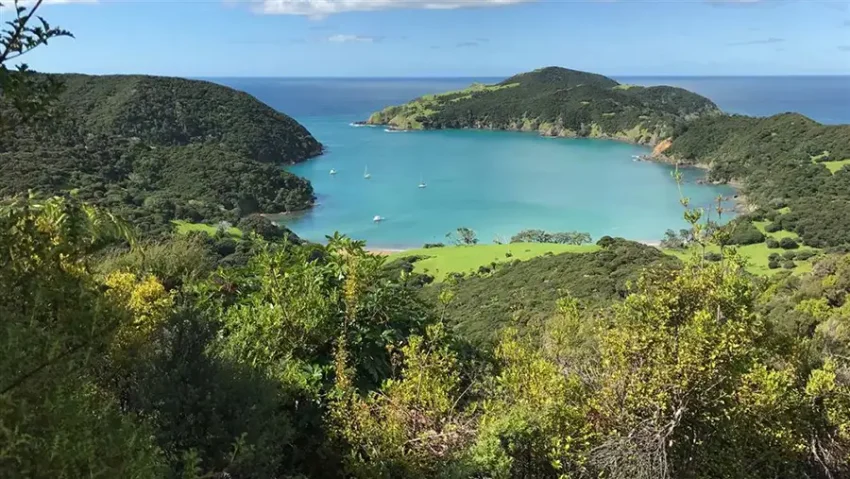
Photo Credits – “Whangaumu Harbour viewed from the track” by Sarah Wilcox is licensed under CC BY 4.0
Map
Sorry, no records were found. Please adjust your search criteria and try again.
Sorry, unable to load the Maps API.