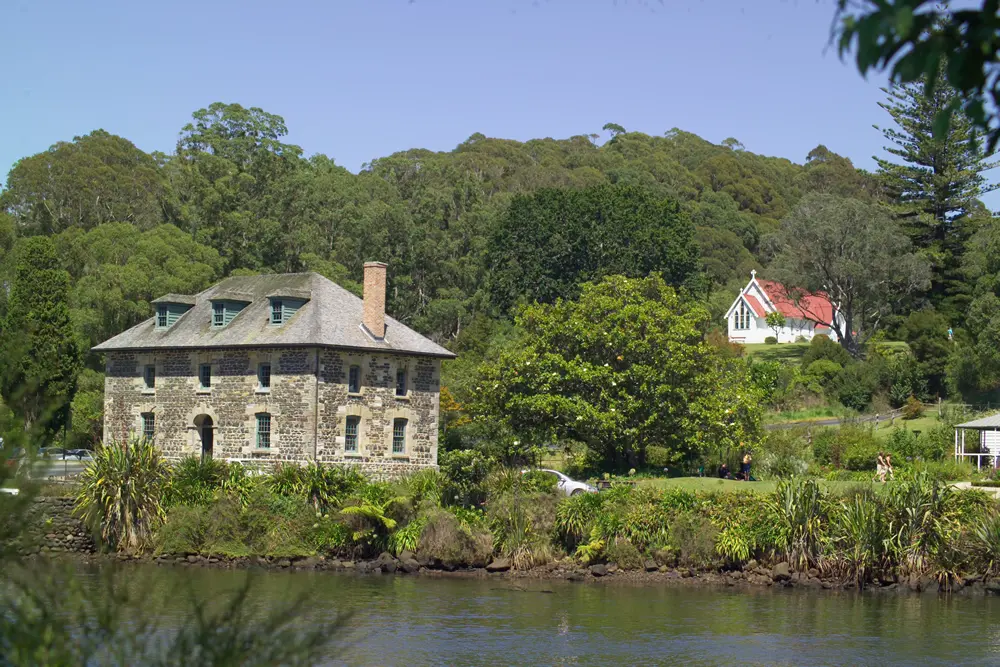
Kerikeri sits inland from the Bay of Islands, sheltered at the head of a tidal inlet where fresh water meets the sea. Today, it’s known for its orchards, artists, and cafés, but this prosperous town holds the distinction of being the site of New Zealand’s oldest European buildings and the country’s very first permanent mission station.
While Paihia may be where the Treaty was signed, Kerikeri is where European settlement in New Zealand truly took root. Here, the first attempts at sustained cross-cultural living were made. Here, books were printed, crops were planted, and the longest-running relationship between a Māori chief and European settlers played out in all its complexity.
For international visitors, Kerikeri offers something remarkable: you can walk into New Zealand’s oldest buildings, stand in rooms that have witnessed two centuries of history, and trace the origins of the unique society that would eventually emerge in Aotearoa.
The Land and Its People
The Kerikeri Basin, with its fertile soil and reliable water supply, had been home to Māori communities for centuries before Europeans arrived. The name Kerikeri itself is believed to come from a Māori term meaning “to dig” or “to drill,” possibly referring to the working of the land or the preparation of food.
This was Ngāpuhi territory, and the land around Kerikeri was under the mana of several hapū. Most significantly, it was closely associated with Hongi Hika, one of the most formidable chiefs in New Zealand history. His pā (fortified village) at Kororipo sat on the headland overlooking the basin, a strategic position that controlled access to the inlet and surrounding lands.
The relationship between Hongi Hika and the European missionaries who would settle here was unlike any other in early New Zealand. It was a partnership born of mutual need, marked by genuine respect, and tested by the violence that swept through the country during the Musket Wars.
Samuel Marsden and the First Mission (1819)
On Christmas Day 1819, the Reverend Samuel Marsden preached the first Christian sermon in New Zealand on Māori land at Oihi Bay, just across the inlet from present-day Kerikeri. It was a symbolic beginning, but the real work started when the Church Missionary Society (CMS) established its first permanent station at Kerikeri in 1819.
Unlike later mission stations, this wasn’t primarily about converting souls, at least not at first. Marsden understood that missionaries needed to prove their practical worth before Māori would listen to their spiritual message. The early missionaries at Kerikeri were instructed to teach useful trades: farming, carpentry, blacksmithing, and other skills that might benefit both Europeans and Māori.
The mission station was built on land provided by Hongi Hika. This wasn’t charity; it was strategy. Hongi saw the missionaries as a source of valuable goods, skills, and connections to the wider world. The missionaries, in turn, relied entirely on Hongi’s protection in what was often a dangerous environment.
Kemp House and the Stone Store
Two buildings stand today as tangible links to those early years, and they’re not just historically significant; they’re architecturally fascinating examples of how Europeans adapted to New Zealand conditions.
Kemp House (originally called the Mission House) was built in 1822 and is New Zealand’s oldest surviving building. Originally constructed for missionary John Butler, it later became home to James Kemp and his family, who lived there for decades. Walking through Kemp House today is an uncanny experience. The rooms are small by modern standards, the kauri timber walls still solid, and you can almost feel the weight of those early years when everything about life in New Zealand was uncertain and new.
The Stone Store, completed in 1836, is New Zealand’s oldest surviving stone building. Built to store mission supplies and trade goods, its Georgian proportions and solid basalt construction look almost comically English in the subtropical Northland landscape. The Store served as warehouse, library, and trading post; a hub where European goods were exchanged for Māori produce and where cultures literally did business with each other.
Both buildings are open to visitors today, meticulously preserved and still standing on their original sites overlooking the basin. There’s something profound about standing in spaces that have been continuously used for two centuries, where the floorboards have been worn smooth by generations of feet.
The Hongi Hika Partnership
No understanding of Kerikeri’s history is complete without understanding Hongi Hika’s role. This powerful chief didn’t simply tolerate the mission; he actively protected it, visited it regularly, and used it as a base for his own ambitions.
In 1820, Hongi travelled to England (accompanied by missionary Thomas Kendall), where he met King George IV, helped scholars compile a Māori dictionary, and observed British society at the height of its imperial power. On his return journey, he traded gifts from the King for muskets in Sydney. Those weapons would fuel his military campaigns throughout the 1820s.
The Kerikeri mission existed in a strange bubble during the Musket Wars. While Hongi led devastating raids against other iwi, the mission station remained a place of relative peace. Hongi’s enemies knew better than to attack a settlement under his protection, and the missionaries walked a delicate line, providing hospitality and medical care to Hongi while privately deploring the violence he unleashed.
When Hongi was mortally wounded in 1828 (from a musket ball that he carried in his body for over a year before succumbing), he was brought to Kerikeri to die. The missionaries attended him in his final days, a testament to the complex relationship they’d maintained. With Hongi’s death, an era ended, but the mission he’d protected continued to grow.
The Printing Press and the Spread of Literacy
In 1835, a printing press arrived at Paihia, but much of the intellectual and translation work that fed it happened at Kerikeri. The mission stations worked together on the enormous task of translating Christian texts into te reo Māori and teaching literacy to Māori communities.
This was revolutionary work, though its motivations were mixed. The missionaries genuinely believed literacy would benefit Māori, but it was also a tool of cultural change. Māori, for their part, embraced literacy with enthusiasm. Being able to read and write became a new form of mana, and Māori literacy rates in the 1840s and 1850s were remarkably high.
Books printed at Paihia circulated through Kerikeri, where Māori students learned to read in their own language. It’s one of history’s ironies that the missionaries’ most lasting contribution may not have been Christianity itself, but the preservation and codification of te reo Māori at a crucial moment.
Agriculture and Adaptation
While other parts of the Bay of Islands focused on shipping and trade, Kerikeri developed as an agricultural centre. The mission’s gardens and orchards were experimental stations where European crops were tested in New Zealand conditions.
Some plants thrived. Citrus fruits, in particular, flourished in Northland’s subtropical climate. Grapes grew well. Wheat was more challenging, but gradually European farming techniques were adapted to New Zealand’s seasons and soils. The missionaries and their Māori neighbours shared knowledge; European tools and crops met Māori understanding of the land.
This agricultural focus shaped Kerikeri’s character. While Russell became notorious as a wild port town, Kerikeri remained quieter, more focused on cultivation than commerce. That agricultural heritage persists today in the orchards and farms that still surround the town.
Rewa’s Village and Everyday Life
Not far from the mission buildings stands a reconstruction of Kororipo Pā, now known as Rewa’s Village after the chief who lived there in the 1830s. This fortified village stood as a counterpoint to the mission station, a reminder that Māori society continued alongside European settlement, not simply replaced by it.
The pā’s defensive ditches and palisades speak to the realities of the period. These were uncertain times, when alliances could shift and old grievances could erupt into violence. Yet daily life continued: crops were grown, fish were caught, families were raised, and gradually the two communities became more interdependent.
Visiting Rewa’s Village today offers a glimpse into what life might have looked like for the Māori community living alongside the mission. The reconstruction is based on drawings from the period and archaeological evidence. It’s not ancient history on display; it’s the lives of people who overlapped with the mission residents, who traded at the Stone Store, who navigated the same complex realities of two worlds colliding.
Beyond the Mission: Colonial Expansion
As New Zealand became a British colony following the Treaty of Waitangi in 1840, Kerikeri’s role shifted. It was no longer the cutting edge of European settlement; that had moved south to Auckland and beyond. But this relative backwater status may have helped preserve its historical buildings, which remained in use rather than being demolished for redevelopment.
The mission station gradually transitioned into a more conventional colonial settlement. More European families arrived. Land changed hands, sometimes fairly, often not. The complex web of relationships between Māori and Europeans became increasingly strained as colonial structures asserted themselves.
By the late 19th century, Kerikeri was a quiet rural township, its dramatic founding years fading into memory. The Stone Store continued as a trading post. Kemp House remained a family home. And slowly, almost imperceptibly, these buildings began to be recognised not just as old structures, but as irreplaceable links to the nation’s founding.
Modern Kerikeri: Heritage and Renewal
The 20th century brought renewed interest in Kerikeri’s historical significance. Both Kemp House and the Stone Store were eventually preserved and opened to the public. The Kerikeri Basin, with its cluster of heritage buildings and beautiful setting, became recognised as one of New Zealand’s most important historical precincts.
But Kerikeri didn’t become a museum town. Instead, it experienced a renaissance as artists, craftspeople, and food producers discovered its charms. The same fertile land and mild climate that attracted the first missionaries now supports orchards producing kiwifruit, citrus, and other crops. The town has become known for its farmers’ markets, art galleries, and food culture.
This blend of history and contemporary vitality makes Kerikeri unique. You can tour a 200-year-old building in the morning and visit a cutting-edge art gallery in the afternoon. You can trace the footsteps of the first European settlers and then taste olive oil from trees planted in the last decade.
The Kerikeri Heritage Trail now links the key historical sites around the basin: Kemp House, the Stone Store, St James Church (built in 1878), and Rewa’s Village. Interpretation boards tell the stories of both Māori and European residents, acknowledging the complex, sometimes uncomfortable truths of early settlement.
Walking Through History
When you visit Kerikeri today, give yourself time to properly explore the basin area. This isn’t a place to rush through.
Start at Kemp House and the Stone Store. Take the guided tours if available; the guides bring the buildings to life with stories of the families who lived and worked here. Notice the details: the hand-adzed timber, the thick stone walls, the views across the basin that haven’t changed in two centuries.
Walk to Rewa’s Village to see the Māori perspective on this shared history. The contrast between the European buildings and the pā settlement is instructive; these were two different worlds existing side by side.
Follow the Kerikeri River Track, a beautiful walk that winds along the water from the basin to the Rainbow Falls. This track follows routes that both Māori and early missionaries would have known, through native bush that gives a sense of what the landscape looked like before extensive European modification.
Visit the Kerikeri Mission Station Heritage Precinct to see how the New Zealand Historic Places Trust has worked to preserve and interpret this crucial site. The exhibitions provide context that helps you understand what you’re seeing.
But don’t stop at the historical sites. Explore modern Kerikeri too. Visit the village shops and galleries. Stop at a café or restaurant. Pick up fresh produce from a roadside stall. The town’s contemporary vitality is part of its story; this is a place that has adapted and evolved while maintaining connections to its past.
Kerikeri isn’t as dramatic a setting as Paihia or Russell, but in some ways, that’s its strength. This is where you can see how settlement actually worked, how people lived, how two cultures negotiated daily existence together. It’s intimate, tangible history; the kind you can touch and walk through and, if you’re paying attention, really understand.
Haere mai ki Kerikeri – come and walk where New Zealand’s European story began.
