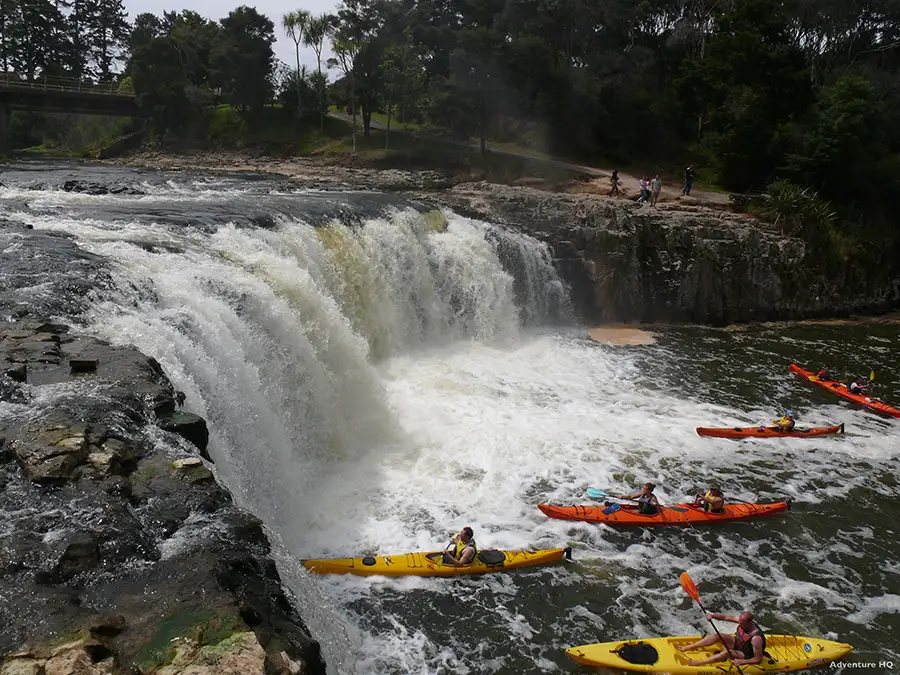

The Haruru Falls Walk is one of those rare tracks that ticks all the boxes without making you work too hard for it. Starting right from Paihia’s waterfront, this easy riverside ramble takes you through mangroves and native bush before delivering you to the horseshoe-shaped Haruru Falls, one of Northland’s most photogenic waterfalls.
It’s popular with everyone from families with young kids to visitors who’ve just stepped off a cruise ship, and there’s good reason for that. The track is gentle, well-maintained, and packed with enough variety to keep things interesting. You’ll cover roughly 6km (3.7 miles) return, or about 3km (1.9 miles) one-way if you arrange transport at the other end. Most people take around 1.5 to 2 hours return at a leisurely pace, with plenty of stops for photos and wildlife spotting.
Getting There
Haruru Falls sits about 3km (1.9 miles) inland from Paihia, just off Puketona Road. The falls themselves are at the head of the Waitangi River estuary, and the walking track follows the southern shoreline from Paihia to get there.
The beauty of this walk is that you can start right from the Paihia waterfront, near the village green. Just head towards the Waitangi Bridge and you’ll pick up the track signage easily enough. If you’re driving, there’s parking at both ends: limited street parking near the Paihia start, and a proper car park at the Haruru Falls end on Haruru Falls Road. Some people prefer to walk one way and get picked up, or you can make it a loop by returning along Puketona Road, though that’s less scenic and involves roadside walking.
Cycling is another good option. The track is shared-use, and many locals bike it. There are also shuttle services in Paihia that can drop you at one end if you only want to walk one way.
The Track
The Haruru Falls Walk is classified as easy, and it lives up to that. The 6km (3.7 miles) return journey typically takes 1.5 to 2 hours, though you could easily stretch that to 3 hours if you’re bird watching or taking your time with photos.
The track is a mix of elevated boardwalks through the mangroves, well-formed gravel paths through native bush, and some sections that follow right along the river’s edge. It’s mostly flat with only gentle inclines, making it accessible for most fitness levels. Families with young children manage it without too much fuss, though you’ll want to keep an eye on little ones near the water’s edge in places.
The boardwalk sections can get slippery when wet, and the track can be muddy after heavy rain, so timing matters. Summer and autumn are ideal, with calmer weather and less mud underfoot. Early morning walks are particularly lovely when the light hits the mangroves and you’ve got the track mostly to yourself. Avoid midday in summer as there’s limited shade in the mangrove sections, and bring insect repellent any time of year.
Waitangi Estuary & Mangrove Boardwalk
The first section of the walk takes you out onto elevated boardwalks threading through Waitangi Estuary’s extensive mangrove forests. These are New Zealand’s only native mangrove species, and they create an otherworldly landscape that shifts completely with the tides.
At high tide, the mangroves appear to float on glassy water that reflects the sky and surrounding hills. At low tide, the mudflats are exposed, revealing the intricate root systems and bringing out wading birds hunting for crabs and shellfish. Keep an eye out for pied stilts, herons, and occasionally the rare banded rail. The birdlife here is excellent, particularly if you’re walking quietly in the early morning or late afternoon.
Forest & Riverside Sections
Once you leave the mangroves behind, the track enters pockets of regenerating native bush. Tree ferns, nikau palms, and various coastal forest species create a shady canopy, and you’ll hear plenty of birdsong. Tūī, fantails, and kingfishers are common, and if you’re lucky you might spot a kererū (native wood pigeon) in the trees.
Small streams cross under the track, and there are spots where you’re walking right beside the Waitangi River. The water here can be surprisingly clear, and when the tide’s right, you’ll see kahawai and mullet cruising past. It’s these quieter forest sections where you really get a sense of what the Bay of Islands looked like before European settlement.
Arrival at Haruru Falls
Your first glimpse of Haruru Falls usually comes with the sound, a constant rush of water that grows louder as you approach. The falls themselves drop about 5m (16 feet) in a graceful horseshoe curve across the full width of the Waitangi River. It’s not a dramatic plunge waterfall, but there’s something appealing about the wide, even cascade.
The best viewing is from the grassy area beside the car park, where you can get right up close to the base of the falls. There’s also a lookout platform that gives you a different perspective. For photos, the horseshoe shape is most apparent from the viewing area on the southern side.
Swimming isn’t really recommended here. The current can be deceptive, and the rocks are slippery. You’ll often see kayakers passing through, though, as this is a popular spot on the river paddle routes.
Cultural & Historical Significance
“Haruru” means “big noise” or “loud sound” in te reo Māori, a straightforward description of the constant roar of the falls. The Waitangi River and this area hold deep significance for local Māori, particularly Ngāpuhi iwi, who have occupied this region for hundreds of years.
The river was an important waterway for travel and trade, and the falls marked a natural boundary for waka (canoe) travel upstream. The Waitangi area itself, just downstream from where you start the walk, is of course famous as the location where the Treaty of Waitangi was signed in 1840, New Zealand’s founding document between Māori chiefs and the British Crown.
Walking this track, you’re following routes that have been used for generations, long before the boardwalks and formed paths existed. The estuary and its resources sustained communities here, and that connection to place is still strong today.
Tips for Walkers
Footwear-wise, decent walking shoes or trainers are fine. The track is well-maintained, but there can be muddy patches and tree roots to navigate. Sandals or jandals aren’t ideal, especially on the boardwalks when wet.
Bring water, particularly in summer. There’s no drinking water along the track, and you can work up a thirst even on an easy walk. Sunscreen and a hat are essential for the exposed mangrove sections, and insect repellent will make your walk more pleasant, especially around dawn or dusk. Don’t forget your camera or phone; the photo opportunities are excellent throughout.
The track is suitable for most fitness levels, but it’s not wheelchair accessible due to steps, uneven surfaces, and some narrow boardwalk sections. Pushchairs can be managed, though it’s bumpy in places and you might need to lift them over a few obstacles.
Dogs are allowed on leads, which is great for locals who want to include their four-legged friends. Do keep them on lead though; there’s wildlife about, and it’s just good practice on shared tracks. Pick up after your dog and take all rubbish with you. The track passes through areas that are recovering ecologically, so stay on the formed path.
Nearby Attractions & Add-On Activities
The Waitangi Treaty Grounds is the obvious nearby attraction, literally adjacent to where the walk begins. If you haven’t visited yet, it’s essential Bay of Islands viewing, with the Treaty House, museum, and spectacular cultural performances. You could easily combine a morning walk to the falls with an afternoon at the Treaty Grounds.
Back in Paihia township, there are plenty of cafés and restaurants for a post-walk meal or coffee. The waterfront has a safe swimming beach, and there’s no shortage of places to book activities like dolphin watching, island cruises, or fishing charters.
For something different, several operators offer kayak tours that paddle under Haruru Falls. It’s a unique perspective and gives you a sense of the power of the water. The combination of walking to the falls and then kayaking under them another day makes for a good Bay of Islands experience.
Other nearby walks include the Cape Brett Track if you’re up for something more challenging, or the various short walks around the Waitangi Treaty Grounds themselves.
Nature-Rich Track
The Haruru Falls Walk delivers a lot for relatively little effort. It’s one of those tracks that works whether you’re a keen walker looking for a morning leg-stretch or a family wanting an achievable outing that keeps everyone interested.
The mix of mangrove boardwalks, riverside forest, and the falls themselves gives you a genuine taste of the Bay of Islands’ natural environment without venturing far from town. The cultural significance of the area adds depth to what might otherwise be just a pleasant riverside stroll, and the accessibility from central Paihia means you can fit it into almost any itinerary.
It’s not wilderness walking, and you won’t have the place to yourself on a summer afternoon, but that’s not really the point. This is a track that reminds you why the Bay of Islands is such a special part of New Zealand, and it does it in under two hours return. Worth the walk.
Map
Sorry, no records were found. Please adjust your search criteria and try again.
Sorry, unable to load the Maps API.