
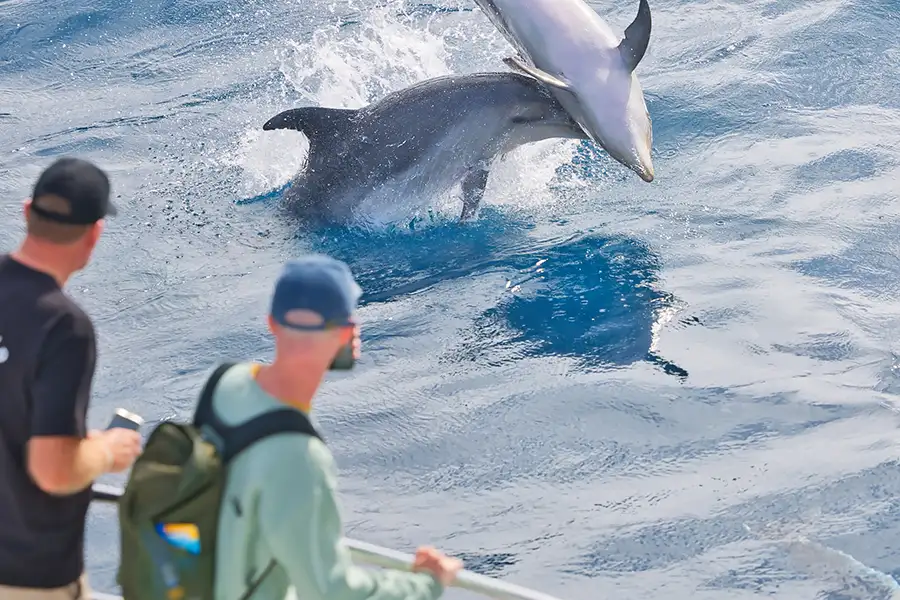

Whale watching in the Bay of Islands offers encounters with several whale species throughout the year. While the bay isn’t New Zealand’s premier whale watching destination like Kaikoura, it provides regular sightings of Bryde’s whales, pilot whales, and occasional visits from migrating humpback whales. As part of the Marine Mammal Sanctuary, these waters offer protected habitat where you can observe whales feeding, travelling, and socialising. This guide covers which whale species you might encounter, the best times for sightings, and how to experience responsible whale watching in the Bay of Islands.
What to Expect from Whale Watching Here
Let’s be honest upfront: whale watching in the Bay of Islands isn’t like Kaikoura, where sperm whales are virtually guaranteed year-round. The bay sees whale sightings, but they’re less predictable and less frequent than dedicated whale watching destinations. When whales do appear, though, it’s a memorable addition to what’s primarily a dolphin and island-focused marine experience.
Several whale species pass through or reside in Bay of Islands waters. Bryde’s whales are the most commonly sighted, appearing year-round though sightings remain unpredictable. Long-finned pilot whales show up regularly, often travelling in social pods. Humpback whales pass through during migration periods, though these sightings are less frequent. Orcas also appear in the bay and have their own distinct behaviour patterns covered in our separate orca guide.
The Bay of Islands Marine Mammal Sanctuary protects these whale populations with the same regulations that govern dolphin watching. Licensed operators understand whale behaviour, know how to approach responsibly, and contribute sighting data to Department of Conservation research.
If you’re visiting the Bay of Islands primarily to see whales, set realistic expectations. You might see them, but it’s not guaranteed the way it is in dedicated whale watching locations.
The Whales You Might See
Bryde’s Whales
Bryde’s whales (pronounced ‘brooders’) are baleen whales with sleek, bluish-grey bodies and pale undersides. They’re medium-sized by whale standards, reaching 12 to 15 metres long and weighing up to 25 tonnes. When they surface to breathe through their two blowholes, they produce a tall, columnar vapour cloud that can reach 3 to 4 metres high. That distinctive blow is often your first indication a whale is nearby.
The easiest way to identify Bryde’s whales is by three distinctive ridges running along the top of their head from the blowhole to the tip of the rostrum. This feature distinguishes them from other baleen whales. They have relatively large eyes and a broad, short head.
Unlike many whale species that migrate long distances, Bryde’s whales are found year-round in New Zealand’s warmer waters, preferring subtropical and tropical seas. They’re usually solitary or travel in pairs, though small groups occasionally form in areas with abundant food. These whales are filter feeders, using their baleen plates to strain small fish, krill, and plankton from the water.
If you’re fortunate, you might witness their unique feeding behaviour: rolling on their sides at the surface or lunging through schools of fish with their mouths wide open. They’re also known to create bubble nets to concentrate prey before feeding. Bryde’s whales are curious and sometimes approach boats, surfacing alongside vessels to investigate. They occasionally breach, though not as spectacularly or frequently as humpback whales.
Long-Finned Pilot Whales
Long-finned pilot whales are technically members of the dolphin family, though at 4 to 6 metres long and weighing up to 2 tonnes, they’re substantially larger than the bay’s resident dolphins. They’re dark grey to black with a distinctive bulbous forehead (called a melon) and a thick, stocky body. Their name comes from their long, swept-back pectoral fins, though you’ll more likely identify them by their rounded heads and prominent curved dorsal fins set forward on their bodies.
Pilot whales are highly social animals, travelling in stable pods of 10 to 30 individuals (sometimes more) that are typically related. These pods have strong social bonds, with members staying together for life. They communicate through complex vocalisations and are known for their deep-diving abilities, regularly descending 300 to 600 metres to hunt squid and deep-water fish.
In the Bay of Islands, pilot whales sometimes approach boats out of curiosity, surfacing near vessels to investigate. They’re generally slow-moving at the surface, often resting or socialising in calm conditions. You might see them ‘logging’ (floating motionless at the surface to rest) or spy-hopping (raising their heads vertically out of the water to look around).
Pilot whales have only 40 to 48 teeth compared to 120 in many other dolphin species, which may indicate evolutionary adaptation towards their squid-heavy diet. Males can live for about 45 years, while females can live for up to 60 years.
Humpback Whales (Occasional Visitors)
Humpback whales sometimes pass through the Bay of Islands during their annual migration between Antarctica and tropical breeding grounds. They’re most likely to be spotted heading north (June to August) or returning south (September to November), though sightings are less common than in other New Zealand locations.
These spectacular whales are easy to identify with their knobbly heads, long pectoral fins (up to a third of their body length), and short humped dorsal fins. They’re famous for breaching (leaping out of the water), tail slapping, and fin slapping. When they do show up in the bay, their acrobatic displays are unforgettable.
Humpbacks can reach 12 to 16 metres long and weigh up to 40 tonnes. They’re baleen whales, filtering small fish and krill through their baleen plates. During migration, they’re focused on travelling rather than feeding, which is partly why sightings in the Bay of Islands tend to be brief encounters as they pass through.
When to See Whales
Year-Round Possibilities
Bryde’s whales and pilot whales can appear at any time of year in the Bay of Islands. There’s no peak season that guarantees sightings. Your best shot at seeing whales is during the warmer months (October to April) when marine life is generally more active and seas are calmer for viewing, but whales can and do appear in winter as well.
Licensed dolphin watching cruises include whale watching as part of the marine mammal viewing experience. Operators report whale sightings, but they’re unpredictable and never guaranteed. Crew are trained to spot the telltale signs: blows on the horizon, dorsal fins, or disturbed water indicating feeding activity.
Humpback Migration Period
Humpback whales are most likely to be spotted during their migration periods:
Northbound migration: June to August, as they travel from Antarctic feeding grounds to warmer tropical waters for breeding
Southbound migration: September to November, returning to Antarctic waters
Even during migration periods, humpback sightings in the Bay of Islands are less frequent than in other New Zealand locations. If seeing humpback whales is your primary goal, consider visiting during the migration window, but understand that sightings aren’t guaranteed.
Whale Watching Tours
The Bay of Islands doesn’t have dedicated whale watching tours the way Kaikoura does. Instead, whale watching is incorporated into dolphin and marine wildlife cruises operated by the two DOC-licensed operators: Fullers Bay of Islands and Explore Group.
These cruises focus primarily on dolphin encounters (which have a 90%+ sighting rate) while also watching for whales, orcas, and other marine life. Crew keep watch throughout the cruise and will adjust routes if whales are spotted or reported in the area. When whales are encountered, boats follow strict DOC approach protocols to ensure safe, respectful viewing.
Tour Options
Fullers Hole in the Rock Dolphin Cruise, Explore Group’s Dolphin Eco Cruise, and Carino Wildlife Cruises Island & Wildlife Day Cruise all include marine mammal viewing with DOC-licensed crews trained to spot and approach whales responsibly. All three operators contribute sighting data to ongoing research and conservation efforts.
Duration ranges from 4.5 to 6 hours, with island stops included. Fullers and Carino operate daily (weather permitting), with Explore Group running seasonally from late October to late April. All operators offer free cancellation up to 24 hours before departure.
What to Expect
Setting Realistic Expectations
The Bay of Islands is excellent for dolphin watching but not a whale watching hotspot. Whale sightings happen, but they’re unpredictable and never guaranteed. Licensed operators are honest about this. Dolphin sightings run over 90% on most trips. Whale sightings are much less frequent.
If whales are your primary interest and you want reliable sightings, Kaikoura on the South Island is New Zealand’s premier whale watching destination, with sperm whales visible year-round on nearly every trip. The Bay of Islands offers a different experience: excellent dolphin encounters with the bonus possibility of seeing whales.
When whale sightings do occur, they’re typically brief encounters as whales pass through the area. Bryde’s whales may surface multiple times, giving you several viewing opportunities. Pilot whales might socialise near the boat if they’re curious. Humpbacks during migration are usually just passing through.
Viewing Protocol
Licensed operators follow strict DOC protocols when approaching whales. Boats maintain required distances, approach from behind or the side (never head-on), and limit interaction time to avoid disturbing the animals. Crew commentary explains what you’re seeing and provides context about the species, their behaviour, and conservation status.
Whales are wild animals with their own agendas. Sometimes they’re feeding and stay in an area. Sometimes they’re travelling and move through quickly. Sometimes they’re curious and approach boats. Licensed operators read the whales’ behaviour and adjust accordingly, prioritising animal welfare over extended viewing time.
Responsible Whale Watching
The same Marine Mammal Sanctuary regulations that protect dolphins also protect whales in the Bay of Islands. These rules exist because unregulated vessel traffic can disrupt feeding, breeding, and migration behaviours.
Marine Mammal Sanctuary Rules
If you’re operating a private vessel, kayaking, or paddling:
- Stay at least 300 metres away from any whale
- If a whale approaches within 300 metres, stop immediately and put your engine in neutral. Stay stopped until they move more than 300 metres away
- Travel at 5 knots or less within 300 metres of any marine mammal
- No one is allowed in the water within 300 metres of any whale
- Never chase, encircle, or attempt to touch whales
Penalties for violations range from infringement fees of $600 to $800, with maximum fines up to $1,600. Serious violations that harm marine mammals can result in fines up to $100,000 and imprisonment. For complete regulations, see the Department of Conservation website.
Why Responsible Viewing Matters
Whales, particularly Bryde’s whales, face multiple threats including vessel strikes, ocean noise, and habitat degradation. The Bay of Islands sanctuary regulations help protect these vulnerable populations by:
- Reducing collision risk through speed restrictions and distance requirements
- Minimising acoustic disturbance that can interfere with whale communication and navigation
- Preventing disruption to feeding, resting, and migration behaviours
- Allowing mother-calf pairs to bond and travel without harassment
Following these rules ensures that whales can continue using the Bay of Islands as safe habitat and that future generations can experience these remarkable animals.
Practical Information
What to Bring
Whale watching requires the same preparation as dolphin cruises:
- Warm, windproof jacket: Essential even in summer
- Binoculars: Critical for spotting distant blows and identifying species
- Camera with good zoom: For photographing whales from the required distance
- Polarised sunglasses: Reduce glare and help spot blows
- Seasickness medication: Take 30 minutes before departure if prone to seasickness
- Layered clothing: Temperature varies between on-deck and in-cabin
For complete packing advice, see our Planning Your Visit guide.
Best Viewing Conditions
Calm seas make whale spotting significantly easier. The telltale blow is more visible against smooth water, and whales are easier to track when surface conditions are calm. Early morning often provides the best conditions with light winds and good visibility.
Strong winds, choppy seas, and rough conditions make spotting whales much harder and can result in cruise cancellations. Licensed operators monitor weather and won’t take you out in unsafe conditions. Spring and summer generally offer more stable weather than winter, though winter can provide excellent visibility on clear days.
Planning Your Whale Watching Experience
Approach whale watching in the Bay of Islands as a bonus possibility, not the primary goal. The bay excels at dolphin encounters, island exploration, and marine wildlife diversity. Whales add to that experience when they appear.
Book a marine wildlife cruise and you’ll almost certainly see dolphins, explore beautiful islands, and experience one of New Zealand’s most stunning coastal environments. Whales showing up makes it remarkable. If they don’t, you’ll still have an excellent day on the water.
If reliable whale watching is your primary goal, Kaikoura remains the place to go with sperm whales visible year-round on nearly every trip. The Bay of Islands offers something different: dolphins, islands, and the possibility of encountering multiple marine mammal species in a protected sanctuary environment.
For comprehensive information about all marine life in the Bay of Islands including dolphins, seals, and penguins, see our Marine Life Guide. For information specifically about orca encounters, see our Orca in the Bay of Islands guide.

Leave a Reply
You must be logged in to post a comment.