
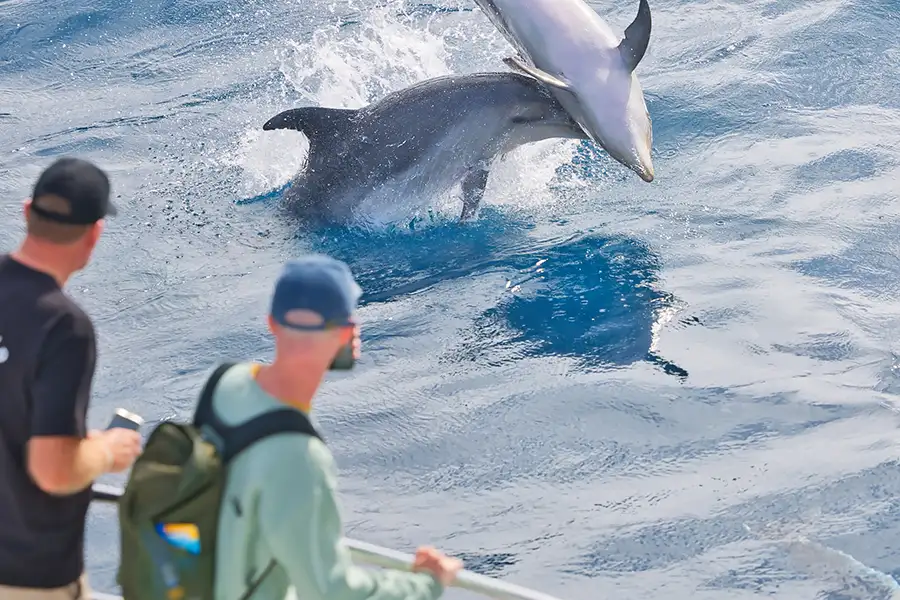
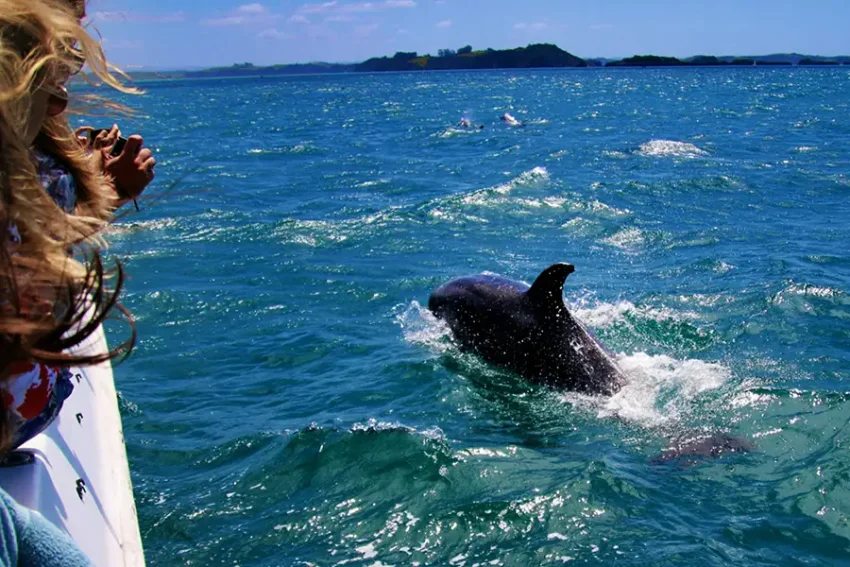
Wildlife viewing in the Bay of Islands happens on the animals’ terms. Dolphins surf boat wakes when they feel like it. Orca sightings bring everyone to a standstill. You might spot a whale’s vapour cloud whilst having your morning coffee on the deck.
The subtropical climate and sheltered waters have created one of New Zealand’s best spots for marine wildlife. Bottlenose and common dolphins live here year-round. Whales pass through on migration routes. Fur seals have claimed the best rocks for sunbathing. The world’s smallest penguins nest along the coast and return to shore each evening like clockwork.
The Bay of Islands became a Marine Mammal Sanctuary in 2021, which means strict conservation rules protect these animals. Whether you’re on a licensed wildlife cruise or watching from shore, you’re in one of New Zealand’s most reliable places to see marine life in their natural habitat.
Dolphins
The Bay of Islands sits within the range of the northern bottlenose dolphin population, which extends from North Cape to the Bay of Plenty and includes around 450 individuals. Common dolphins also frequent these waters.
The bottlenose population visiting the Bay of Islands has declined sharply over recent decades. Research from 2020-2024 shows approximately 26 recognisable individuals regularly use the bay, down from 278 in 1999. That’s a 91% decline, which explains why the Marine Mammal Sanctuary rules are so strict.
Species
Two species swim in Bay of Islands waters:
Bottlenose dolphins reach up to 4 metres long and weigh up to 300kg. You’ll recognise them by short beaks, robust bodies, and distinctively hooked dorsal fins. Curious and intelligent, they often investigate boats and swimmers. These dolphins live in pods ranging from a few individuals to over 20, communicating through clicks, whistles, and body language. They hunt fish, squid, and occasionally small sharks.
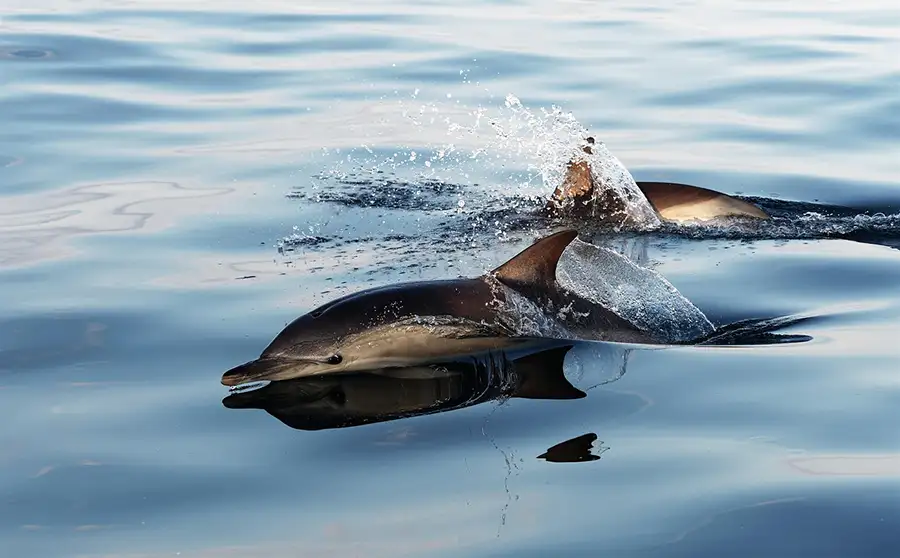
Common dolphins are smaller at 1.9-2.5 metres long, with a more streamlined shape. Look for their tall curved dorsal fins and distinctive hourglass pattern – pale yellow or cream patches along their sides contrasting with dark backs. These are the acrobats. They launch themselves out of the water in spinning leaps and love bow-riding. Common dolphins travel in larger pods than bottlenose, sometimes dozens at a time, feeding mainly on small schooling fish and squid.
Behaviour and Best Viewing Times
Dolphins live in the Bay of Islands year-round, but their behaviour changes with the seasons. October to April brings warmer water, and dolphins stay closer to the surface and within the sheltered bays. This is when you’ll see aerial displays, bow-riding, and social interaction between pods.
Summer brings calmer seas and better visibility, making it easier to spot dolphins from boats and shore. You might see them working together to herd fish, or teaching young calves to hunt.
Winter sightings still happen regularly – these dolphins live here – but they roam into deeper water and become less predictable. You’re more likely to find them in the outer reaches of the bay. Aerial displays drop off in cooler water.
Where to See Dolphins
Dolphins range throughout the Bay of Islands. The channels between islands, particularly around Moturua Island and Urupukapuka Island, see consistent activity. The deeper waters near the bay’s entrance towards Cape Brett attract dolphins hunting in nutrient-rich currents. Early morning and late afternoon often bring them into the inner harbour around Paihia and Russell.
Licensed Dolphin Viewing
Two operators hold Department of Conservation licences for marine mammal viewing: Fullers Bay of Islands and Explore Group.
Licensed operators matter. Their crews know how to approach dolphins responsibly. They follow strict protocols to keep encounters safe. Captains can read dolphin behaviour to tell if a pod wants interaction or should be left alone. Licensed operators also report sightings and observations to DOC, contributing to ongoing research and conservation.
Both run daily cruises when weather permits. Experienced crew share information about the dolphins you’re seeing, their individual behaviours, and the conservation efforts protecting them.
For more detailed information about dolphin watching cruises, booking, and what to expect, visit our Dolphin Watching page.
Whales
Dolphins get most of the attention, but several whale species pass through the Bay of Islands year-round. You need more luck to spot them than dolphins, but it happens often enough to stay interesting. When it does happen, it’s unforgettable.
Orca (Killer Whales)
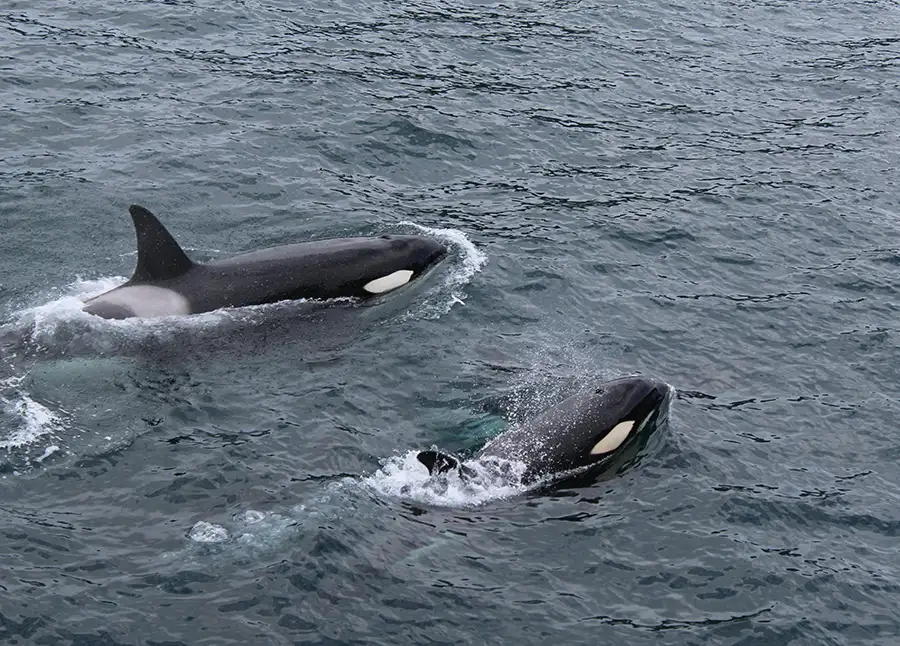
Orca are technically the largest dolphin family members, though at up to 9 metres long and 6 tonnes, they don’t look like their smaller cousins. The black and white colouration gives them away instantly – black backs and sides with white eye patches and a distinctive white saddle patch behind the dorsal fin.
Males have enormous dorsal fins reaching 1.8 metres tall, standing upright like a shark fin cutting through the water. Females and juveniles have smaller, more curved dorsal fins.
When orca show up in the Bay of Islands, the dolphins clear out. Orca are apex predators with no natural enemies. Whilst they mainly hunt fish, seals, and rays in New Zealand waters, dolphins don’t take chances. If your dolphin-watching cruise suddenly goes quiet, look for orca.
Orca travel in tight family pods led by matriarchs. They have complex social structures and pass hunting strategies down through generations. Different pods have different dialects – essentially speaking different languages. New Zealand’s orca population is relatively small and well-studied. Researchers have recognised and tracked some individuals.
Sightings happen throughout the year but are unpredictable. Orca often follow stingray migrations and seal colonies, appearing more frequently where prey is abundant. When spotted, they’re usually travelling steadily through the bay, occasionally stopping to hunt or socialise.
For comprehensive information about seeing Orca, best viewing seasons, and species identification, visit our Orca page.
Bryde’s Whales
Bryde’s whales (pronounced “brooders”) have sleek bluish-grey bodies and white or pale undersides. Medium-sized by whale standards – 12-15 metres long and up to 40 tonnes – they’re still impressive when they surface near your boat.
Watch for the tall columnar vapour cloud when they breathe through two blowholes. That distinctive blow can reach 3-4 metres high and is often your first sign a whale is nearby. Bryde’s whales have three distinctive ridges running along the top of their head from the blowhole to the tip of the upper jaw, which helps identify them.
Unlike many whale species that migrate long distances, Bryde’s whales stay in New Zealand’s warmer waters year-round. They prefer subtropical and tropical seas. Usually solitary or travelling in pairs, small groups occasionally form where food is abundant.
These are filter feeders, using baleen plates to strain small fish, krill, and plankton from the water. If you’re lucky, you might see their unique feeding behaviour: rolling on their sides at the surface or lunging through fish schools with mouths wide open. They also blow bubble nets to concentrate prey before feeding.
Bryde’s whales can be curious and sometimes approach boats, surfacing alongside vessels. They occasionally breach, though not as spectacularly or frequently as humpback whales.
Long-Finned Pilot Whales
Long-finned pilot whales are another dolphin family member, though at 4-6 metres long and up to 2 tonnes, they’re substantially larger than the bay’s resident dolphins. Dark grey to black with a distinctive bulbous forehead and thick stocky body.
The name comes from their long swept-back pectoral fins, though you’ll more likely spot them by their rounded heads and prominent curved dorsal fins set forward on their bodies.
Pilot whales are highly social, travelling in stable pods of 10-30 individuals that are typically related. These pods have strong social bonds. Members stay together for life. They communicate through complex vocalisations and can dive deep – regularly descending 300-600 metres to hunt squid and deep-water fish.
In the Bay of Islands, pilot whales sometimes approach boats out of curiosity, surfacing near vessels. Generally slow-moving at the surface, they’re often resting or socialising in calm conditions. You might see them logging – floating motionless to rest – or spy-hopping, raising their heads vertically out of the water to look around.
Other Occasional Visitors
Whilst orca, Bryde’s whales, and pilot whales are most commonly sighted, the Bay of Islands occasionally hosts other species.
Humpback whales sometimes pass through during annual migration between Antarctica and tropical breeding grounds. June to August they head north, September to November they return south. These spectacular whales are known for breaching, tail slapping, and their long pectoral fins.
Sperm whales, the largest toothed whales, occasionally appear in deeper waters near the bay’s entrance. Males can reach 18 metres long. You’ll identify them by massive block-shaped heads and low angled blows.
Best Times for Whale Watching
Your best chance at whale sightings is October to April when marine life is most active and seas are calmer. But whales can appear any time of year. They don’t follow schedules.
Both Fullers and Explore Group include whale watching in their marine wildlife cruises. Crew are trained to spot the telltale signs: blows on the horizon, dorsal fins, disturbed water indicating feeding. Whale sightings are never guaranteed – wild animals in a vast ocean – but when they appear, it’s always a highlight.
For comprehensive information about whale watching tours, best viewing seasons, and species identification, visit our Whale Watching page.
Seals
New Zealand fur seals (kekeno in Māori) are common along the Bay of Islands coastline. You’ll find them sprawled on rocks, beaches, and occasionally boat ramps, napping through most of the day.
Identification and Behaviour
Fur seals are easy to identify. Small external ears, long whiskers, pointed snout. Males are significantly larger than females – up to 180kg compared to females’ 70kg. Their fur appears dark brown or grey when dry, almost black when wet.
The daytime laziness makes sense. Fur seals hunt at night when prey comes closer to the surface – fish, squid, octopus, occasionally seabirds. Remarkably skilled hunters, they dive up to 200 metres deep and stay underwater for several minutes. Daytime is for recovering, digesting, and conserving energy for the next hunt.
Where to See Seals
Fur seals haul out on rocky coastlines, small beaches, and sheltered coves throughout the Bay of Islands.
Rocky outcrops around Tapeka Point near Russell see regular visitors. Remote beaches on the outer islands host colonies. Rocks near the entrance to the bay towards Cape Brett are popular. Occasionally they turn up on boat ramps and marina pontoons.
Pups are born in late spring and early summer (November-January), making this an excellent time to see colonies with young. Mother seals are extremely protective and can become aggressive if threatened.
Viewing Safety
Despite looking cuddly and relaxed, fur seals move surprisingly fast and will bite if cornered or threatened. Adult males are particularly territorial during breeding season (November-January).
Keep at least 20 metres away from seals on land. If a seal raises its head, opens its mouth, or makes noise, you’re too close. Back away slowly. Never position yourself between a seal and the water – they may charge if their escape route feels blocked.
Seals are better appreciated from a safe distance. Bring binoculars or a good zoom lens.
Penguins
Kororā (little blue penguin) are the world’s smallest penguin species and one of the Bay of Islands’ most charming marine residents. Standing just 25cm tall and weighing around 1kg, they’re roughly the size of a rugby ball with flippers.
Identification and Behaviour
Little blue penguins are unmistakable. Distinctive slate-blue plumage on backs and wings, white undersides, tiny flippers. Unlike their Antarctic cousins, these penguins prefer temperate climates and are found only in New Zealand and southern Australia.
Excellent swimmers, they reach speeds of up to 6km/h underwater and dive up to 35 metres deep hunting small fish, squid, and krill. Their compact size and streamlined shape make them highly manoeuvrable underwater. On land they’re somewhat awkward and comical, waddling on short legs and using flippers for balance.
Where and When to See Them
Little blue penguins nest in burrows on offshore islands and secluded coastal areas throughout the Bay of Islands. Rarely seen during the day – they spend daylight hours at sea hunting. The magic happens at dusk.
As twilight falls, penguins return to shore in small groups called rafts, swimming in together for safety from marine predators. They emerge from the water, shake themselves dry, and waddle up beaches to their burrows. Locals and visitors call it the penguin parade.
You might hear them before you see them. Little blue penguins are surprisingly vocal, making distinctive braying, trumpeting calls that sound almost like a donkey. During breeding season (June to March), coastal areas near colonies get quite noisy at twilight as returning penguins call to their mates and chicks in burrows.
Breeding and Conservation
Breeding season runs from June to March. Most eggs are laid in August-September. Both parents share incubation duties and chick-rearing responsibilities, taking turns hunting at sea and guarding the burrow. Chicks fledge at about 7-8 weeks old.
Little blue penguins face threats from introduced predators like stoats, cats, and dogs, plus habitat loss and disturbance. Some offshore islands in the Bay of Islands have become important sanctuaries after pest eradication programmes.
Responsible Viewing
If you’re near shore at dusk when penguins are returning:
- Stay still and quiet
- Never use flash photography
- Keep dogs well away from penguin areas
- Don’t block their path between water and burrows
- Never attempt to touch or feed them
- Report injured or stranded penguins to DOC
The best way to see little blue penguins is on guided tours to offshore islands where they nest, or by watching quietly from coastal vantage points at dusk during breeding season.
Important: Marine Mammal Sanctuary Rules
The Bay of Islands is a Marine Mammal Sanctuary. Strict rules protect dolphins, whales, seals, and other marine life. These rules exist because unregulated vessel traffic and human interaction disrupt feeding, breeding, and resting behaviours, causing long-term harm to marine mammal populations.
If you’re on a private boat, kayaking, swimming, or diving, here’s what you need to know:
Distance Requirements
Stay at least 300 metres away from any marine mammal (dolphins, whales, seals in the water). If a marine mammal approaches within 300 metres of your vessel, stop immediately and put your engine in neutral. Stay stopped until they move more than 300 metres away.
If you’re swimming, snorkelling, or diving and a marine mammal approaches, remain calm and still in the water. Don’t attempt to touch or chase them.
Speed Restrictions
Travel at 5 knots or less within 300 metres of marine mammals. Travel at 5 knots or less in designated marine mammal safe zones (marked on nautical charts). Slow approaches help prevent collisions and reduce underwater noise that can disturb or disorient marine mammals.
Water Activities
No one is allowed in the water (swimming, snorkelling, diving, paddling) within 300 metres of a marine mammal. This protects both humans and animals. Dolphins and whales can accidentally injure swimmers. Human presence disrupts natural behaviours.
Licensed Operators
Licensed tour operators like Fullers and Explore Group operate within these rules under strict DOC guidelines. They use trained skippers who understand marine mammal behaviour, maintain safe approach protocols, and limit interaction times to prevent harassment or disturbance.
If you’re operating your own vessel, maintain the required distances. The fines aren’t trivial:
- Up to $1,600 for infringement notices
- Up to $100,000 and imprisonment for serious violations that harm marine mammals
Why These Rules Matter
These regulations are based on scientific research showing that repeated disturbance can force dolphins and whales to abandon feeding areas or resting spots, disrupt mother-calf bonding and teaching behaviours, increase stress levels affecting health and reproduction, and alter natural movement patterns and habitat use.
Following these rules ensures future generations can experience the same incredible marine life that makes the Bay of Islands special.
For complete regulations and updates, visit the Department of Conservation website.
Coastal Viewing Locations
Licensed boat cruises offer the best opportunities to see marine life up close, but several coastal locations provide excellent shore-based viewing.
Tapeka Point, Russell: Rocky headland with elevated views across the bay. Good for spotting dolphins, occasionally whales in the distance, and fur seals on nearby rocks. Accessible via walking track.
Flagstaff Hill, Russell: The highest point in Russell offers panoramic views over the entire bay. Bring binoculars to scan for dolphin activity, whale blows, and bird activity indicating feeding frenzies.
Paihia Waterfront: Easy access viewing from the beach and boardwalk. Dolphins occasionally swim close to shore, particularly early morning and late afternoon.
Cape Brett Track lookouts: For committed hikers, the Cape Brett Track offers spectacular clifftop views over open ocean where whales are occasionally spotted during migration.
Urupukapuka Island: Multiple viewpoints around the island accessible by ferry, with elevated spots for watching dolphin activity in the channels below.
Best viewing times from shore are typically early morning (6-9am) and late afternoon (4-7pm) when marine life is most active and lighting conditions are ideal for spotting movement on the water.
Planning Your Marine Life Experience
The Bay of Islands offers marine life viewing opportunities year-round, though your experience varies by season.
Summer (December to February)
Peak season for marine wildlife. Dolphins are most active and reliably found in sheltered bays. Calm seas and clear visibility make for ideal viewing. Whales pass through regularly. Seals are visible hauled out on rocks throughout the day. Water temperatures reach 20-23°C.
Weather is generally stable with light winds, though summer storms can occasionally disrupt viewing. Book cruises in advance – this is the busiest tourist season.
Autumn (March to May)
Excellent conditions continue with pleasant temperatures and fewer crowds. Waters remain warm enough (18-21°C) to keep dolphins active and visible. Whale sightings remain possible as some species extend their feeding time before migration. Seals show increased activity as breeding season approaches.
This is arguably the best time for marine wildlife viewing. You get summer-like conditions without peak-season crowds and prices.
Winter (June to August)
The quietest season but dolphins are still present and sightings remain regular. Water temperatures drop to 15-17°C. Dolphins may range into deeper waters, making them slightly less predictable but still frequently encountered.
Seas can be rougher with stronger winds and larger swells, occasionally cancelling cruises. Clear winter days offer excellent visibility and dramatic lighting for photography. This is also penguin breeding season, making dusk viewings from shore more rewarding.
Advantages: fewer tourists, better prices, and you’ll often have encounters to yourself.
Spring (September to November)
Nature reawakens with increasing marine activity as waters warm (17-20°C). Dolphins become more active and predictable. Whale migration activity increases, particularly humpbacks passing through. Seal pups are born in late spring, making coastal colonies more interesting.
Weather becomes more settled, though spring winds can still create choppy conditions. An excellent shoulder season combining good wildlife activity with moderate crowds.
Time of Day Considerations
Early morning (6-9am): Often the calmest seas and best light for photography. Marine life is actively feeding. Fewer boats on the water.
Midday (10am-2pm): Busiest time for tour departures. Good for calm conditions but can be bright and hazy for photography.
Late afternoon (3-6pm): Marine life becomes active again as the day cools. Beautiful light for photography. Potential to see penguins returning to shore at dusk.
Booking Recommendations
Book licensed wildlife cruises through Fullers or Explore Group at least 24-48 hours in advance during peak season. Check weather forecasts before booking – strong winds and rough seas impact sightings and comfort. Morning cruises often have calmer seas, especially in summer. Multi-day visits increase your chances of sightings. Marine wildlife is never guaranteed on any single trip.
Responsible Marine Wildlife Viewing
When experiencing the Bay of Islands’ marine life, follow these principles to protect the animals and their habitat.
On the Water
Always follow Department of Conservation guidelines and Marine Mammal Sanctuary rules. If operating your own vessel, maintain 300-metre distances from all marine mammals. Never chase, encircle, or attempt to touch marine wildlife. Avoid sudden movements or loud noises that might startle animals. Limit your time observing any individual animal or pod. Even from legal distances, prolonged attention can disrupt natural behaviour. Never feed marine wildlife – it alters natural behaviour and can make them dependent on humans.
From Shore
Keep at least 20 metres from seals and sea lions on beaches and rocks. Never position yourself between a seal and the water. Keep dogs on leashes and away from seal haul-out areas and penguin colonies. Watch penguins returning at dusk from a distance. Don’t block their paths or use flash photography. Report injured, stranded, or distressed marine animals to DOC (emergency hotline: 0800 DOC HOT / 0800 362 468).
Photography Guidelines
Use zoom lenses instead of approaching animals closely. No flash photography of penguins or seals – it disorients them and makes them vulnerable. Avoid drones near marine mammals. They can cause significant stress and disturbance. Prioritise animal welfare over getting the shot.
Supporting Conservation
Book with licensed, responsible operators who contribute to conservation research. Consider donating to or volunteering with marine conservation organisations working in the Bay of Islands. Share your sightings with DOC or research organisations – citizen science data helps monitor populations. Educate others about sanctuary rules and responsible viewing practices.
Choosing Licensed Operators
When booking marine wildlife experiences, verify operators hold current DOC permits for marine mammal viewing. Ask about their conservation practices and contributions to research. Look for operators with experienced crew who can educate you about the animals. Avoid operators who guarantee sightings or promise close encounters – responsible operators know wildlife is unpredictable. Choose companies that limit group sizes and interaction times to minimise disturbance.
Following these guidelines ensures these incredible animals continue to thrive in the Bay of Islands for future generations.
Tours and Experiences
Licensed Marine Wildlife Cruises
Two operators hold Department of Conservation licences for marine mammal viewing in the Bay of Islands.
Fullers Bay of Islands
- Hole in the Rock Dolphin Cruise with island stopover
- Daily departures (weather permitting)
- Experienced crew with detailed local knowledge
- Contributes to ongoing marine mammal research and conservation
Explore Group Bay of Islands
- Discover the Bay cruise with marine wildlife viewing and island lunch
- Daily departures (weather permitting)
- Licensed for responsible marine mammal encounters
- Smaller vessel options for more intimate experiences
Both operators provide expert commentary, follow strict DOC protocols, and have high success rates for dolphin sightings. Remember: whales are possible but never guaranteed. Cruises typically run 3-4 hours and include island stopovers for swimming and exploring.
What to Bring
Sunscreen and hat: Sun reflects off water – you’ll burn faster than you think.
Sunglasses: Polarised lenses help spot marine life beneath the surface.
Layered clothing: It’s often cooler on the water. Bring a windproof jacket.
Camera with zoom lens: For respectful wildlife photography from distance.
Binoculars: For spotting distant blows and dorsal fins.
Motion sickness medication: Take it 30 minutes before departure if prone to seasickness.
Water and snacks: Though most cruises provide refreshments.
Setting Realistic Expectations
Marine wildlife viewing is never guaranteed. You’re watching wild animals in their natural environment, not a zoo or aquarium.
Dolphin sightings are extremely likely – over 90% success rate most of the year. Whale sightings are possible but less predictable. Seals are frequently spotted on coastal rocks. Penguin sightings require being in the right place at dusk. Weather conditions significantly impact both sightings and comfort.
Licensed operators won’t take you out in unsafe conditions, and they can’t control what wildlife appears. What they can guarantee is responsible, educational, and respectful encounters that prioritise animal welfare whilst giving you the best possible chance to see the Bay of Islands’ incredible marine life.

Leave a Reply
You must be logged in to post a comment.