The Manginangina Kauri Walk is one of those rare tracks that delivers a profound experience in minimal time and distance. This short boardwalk loop through Puketi Forest takes you among ancient kauri trees in 15 minutes, yet it’s as genuine an old-growth forest encounter as walks ten times its length.
What makes this walk so appealing is the combination of accessibility and authenticity. The fully boardwalked 350-metre loop is manageable for almost anyone: families with young children, older walkers, people using wheelchairs. Yet you’re walking among kauri that have stood for up to 1,000 years, experiencing forest that represents what much of Northland looked like before extensive logging transformed the landscape.
The atmosphere is immersive from the moment you step onto the boardwalk. Towering kauri create a cathedral-like space, while tree ferns, ground ferns, and mosses cover the forest floor and fallen logs. A large viewing area set in the kauri grove lets you sit and look up at these remarkable trees.
This walk suits families wanting to introduce children to native forest, casual walkers who value quality over distance, photographers after that perfect forest shot, and anyone wanting to experience Northland’s kauri heritage without committing to a long or difficult hike.
Location and Access
The Manginangina Kauri Walk sits within the Puketi Forest section of the larger Puketi-Omahuta Forest complex, one of Northland’s most significant remaining tracts of native forest. The walk is about 20 km from Kerikeri, roughly 25 minutes’ drive following well-signposted country roads that are sealed for most of the journey with a final gravel section.
From Kerikeri, head towards Waipapa and follow the signs to Puketi Forest. The route is clearly marked, though you’re leaving town behind and heading into rural Northland. The roads suit standard vehicles. You don’t need a 4WD, though the gravel sections require moderate speeds.
The small car park at the walk has space for about 10 to 15 vehicles. It rarely fills completely given how far off the beaten track this location is, though summer weekends can get busier. There are no toilets at the walk itself. The nearest facilities are back in Kerikeri, so come prepared, particularly if you’re bringing children.
The Track
The Manginangina Kauri Walk covers 350 metres in a loop that takes about 15 minutes, including time to stop, look up at the kauri, and read interpretation panels. You could rush it in less, but that defeats the purpose. This is a walk to linger over, not hurry through.
The track is graded very easy and genuinely is easy. The entire route is boardwalked, protecting the sensitive kauri root systems while providing a solid, even surface. The boardwalk is wide enough for two people to pass comfortably, and the gradient is gentle throughout with no steps or significant elevation change. The track is wheelchair accessible.
The loop configuration means you’re walking different sections on the way out and back, seeing different trees and forest environments rather than simply retracing your steps. Interpretation panels at key points explain what you’re seeing and provide context about kauri ecology and conservation.
Ancient Kauri and Forest Ecology
The kauri themselves are why you’re here, and they don’t disappoint. These ancient trees tower above the surrounding forest, some reaching 40 to 50 metres in height with trunks several metres in diameter. Some are estimated to be over 1,000 years old. Standing at the base of a living organism that’s been growing for centuries creates a powerful sense of perspective.
Kauri have a distinctive appearance. The massive straight trunks, often clear of branches for the first 10 to 15 metres, create columns supporting a spreading canopy far above. The bark is greyish with a distinctive texture, shedding in plates as the tree grows.
The boardwalk gets you close to these taonga (treasured) species while protecting their shallow, wide-spreading root systems from soil compaction and foot traffic damage. Kauri roots are vulnerable to damage, making the boardwalk essential for their protection.
Beneath and around the kauri, the forest floor and mid-canopy create a layered environment rich with species. Tree ferns, ground ferns, mosses, kiekie climbing the trunks, and countless seedlings create that lush, green character that defines New Zealand native bush. The understory is particularly vibrant after rain, when everything glistens.
Cultural and Conservation Significance
Kauri hold profound significance for Māori, representing strength, endurance, and connection to ancestors. These trees provided timber for waka (canoes), buildings, and carving, while their gum was used for fire-starting and other practical applications.
The extensive logging of kauri forests from European arrival through to the early 20th century removed an estimated 95% of New Zealand’s original kauri forest. What remains, including the trees at Manginangina, represents a tiny fraction of what once existed. That makes these surviving forests invaluable both ecologically and culturally.
Puketi Forest is one of Northland’s key biodiversity strongholds, protecting not just kauri but the entire forest ecosystem. The forest supports threatened species including native bats, birds, and invertebrates that can’t survive in modified or young forests. Current conservation work includes intensive pest control targeting rats, possums, and stoats.
Birdlife
Forest birdlife is present throughout the walk. Tūī are common and vocal, though the density of the canopy means you’re more likely to hear them than see them clearly. Their complex songs are one of the defining sounds of this forest.
Fantails are almost guaranteed companions, working the mid-canopy and lower levels, catching insects. Their acrobatic flight and curious nature make them entertaining to watch. Listen for grey warblers with their distinctive rising trill, silvereyes moving through in small flocks, and the occasional glimpse of a kererū in the upper canopy.
The atmosphere created by birdsong, rustling leaves, filtered light, and the occasional breeze in the canopy is as much a highlight as the specific species you see.
Best Time to Visit
The walk is accessible year-round. Summer brings warm temperatures and vibrant greens throughout the forest, with dappled light creating beautiful patterns on the forest floor. Summer also sees the most visitors, particularly during school holidays.
Winter offers a different atmosphere. The forest can be misty, with low clouds caught in the canopy and moisture dripping from leaves. The colours shift to deeper greens and browns, and the forest smells rich with damp earth and kauri resin. Winter walking is quieter with fewer visitors.
The boardwalk surface can become slippery when wet, particularly where moss or algae has established on the wood. After rain or in damp conditions (common in this forest), watch your footing and take your time.
Kauri Dieback: Essential Hygiene Protocols
Kauri dieback hygiene is absolutely essential and non-negotiable. This soil-borne disease is killing kauri throughout Northland, and human foot traffic is a primary vector for spreading it. Here’s what you must do:
- Clean your footwear thoroughly before arriving. Remove all soil and organic matter. If your shoes are muddy, clean them before you leave home.
- Use the cleaning stations at the track entrance. Scrub your shoe soles with the provided brushes and spray them with the disinfectant solution. This takes two minutes and could save trees that have stood for centuries.
- Stay on the boardwalk at all times. Don’t step off onto the forest floor, don’t touch the kauri roots, and don’t take shortcuts.
- Clean your footwear again when leaving to avoid taking contaminated soil to other locations.
These protocols aren’t optional or suggestions. They’re essential disease management practices that every visitor has a responsibility to follow. The survival of Northland’s remaining kauri depends on whether visitors take these measures seriously.
Practical Information
What to bring:
- Comfortable walking shoes (closed-toe recommended)
- Insect repellent (mosquitoes and sandflies can be present)
- Water
- Camera
- Light rain jacket if conditions are uncertain
Facilities: None at the walk itself. No toilets, no water. The nearest facilities are in Kerikeri, about 25 minutes’ drive away. Use facilities before you leave town.
Timing: The walk is accessible at any time of day, though morning and late afternoon offer the best light for photography.
Dogs: Not permitted. Puketi Forest has restrictions on dogs to protect wildlife and reduce the risk of spreading kauri dieback disease.
Cost: Free. This is Department of Conservation land with no entry fees.
Nearby Walks
The Manginangina Kauri Walk combines well with other Puketi Forest experiences. The Puketi Forest headquarters area has longer walking options including the Puketi Nature Trail for those wanting more extensive forest walking.
Other tracks in the Puketi-Omahuta complex range from short walks to multi-day tramping routes. The Omahuta Forest section has additional kauri walks, though they require longer drives.
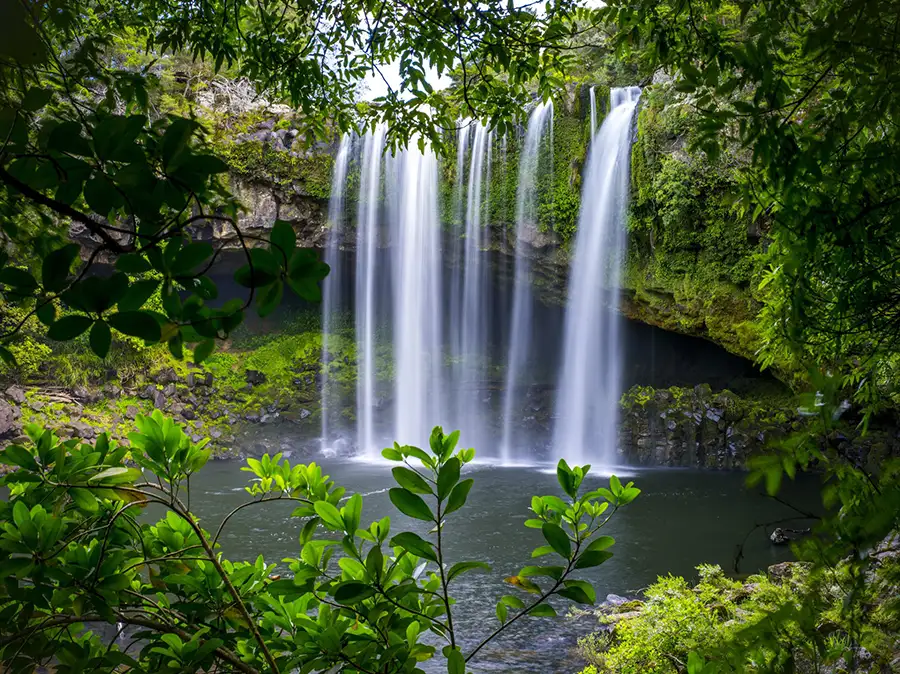
Back in Kerikeri, you can combine your forest visit with Rainbow Falls for waterfall scenery, the Stone Store Basin for history and heritage, or the various orchards and cafés around Kerikeri.
Worth the Drive
The Manginangina Kauri Walk proves that duration and distance don’t determine significance. This 350-metre boardwalk loop delivers an encounter with ancient forest that many longer, more demanding walks struggle to match. The accessibility means almost anyone can experience it, while the quality of the forest ensures that experience is genuine.
Standing among kauri that were already ancient when New Zealand was colonised provides perspective that’s increasingly hard to find. These trees connect us to deep time and to the ongoing responsibility we have to protect what remains.
For families, it’s an ideal introduction to native forest that children can manage easily. For photographers, the light and composition opportunities are excellent. For anyone interested in New Zealand’s natural heritage, it’s a tangible connection to forests that once covered vast areas and now survive in precious fragments.
Follow the hygiene protocols, walk the boardwalk with appropriate care and respect, and allow yourself time to simply be present among these remarkable trees. The Manginangina Kauri Walk is one of the simplest and most rewarding forest experiences in Northland.
Map
Sorry, no records were found. Please adjust your search criteria and try again.
Sorry, unable to load the Maps API.